
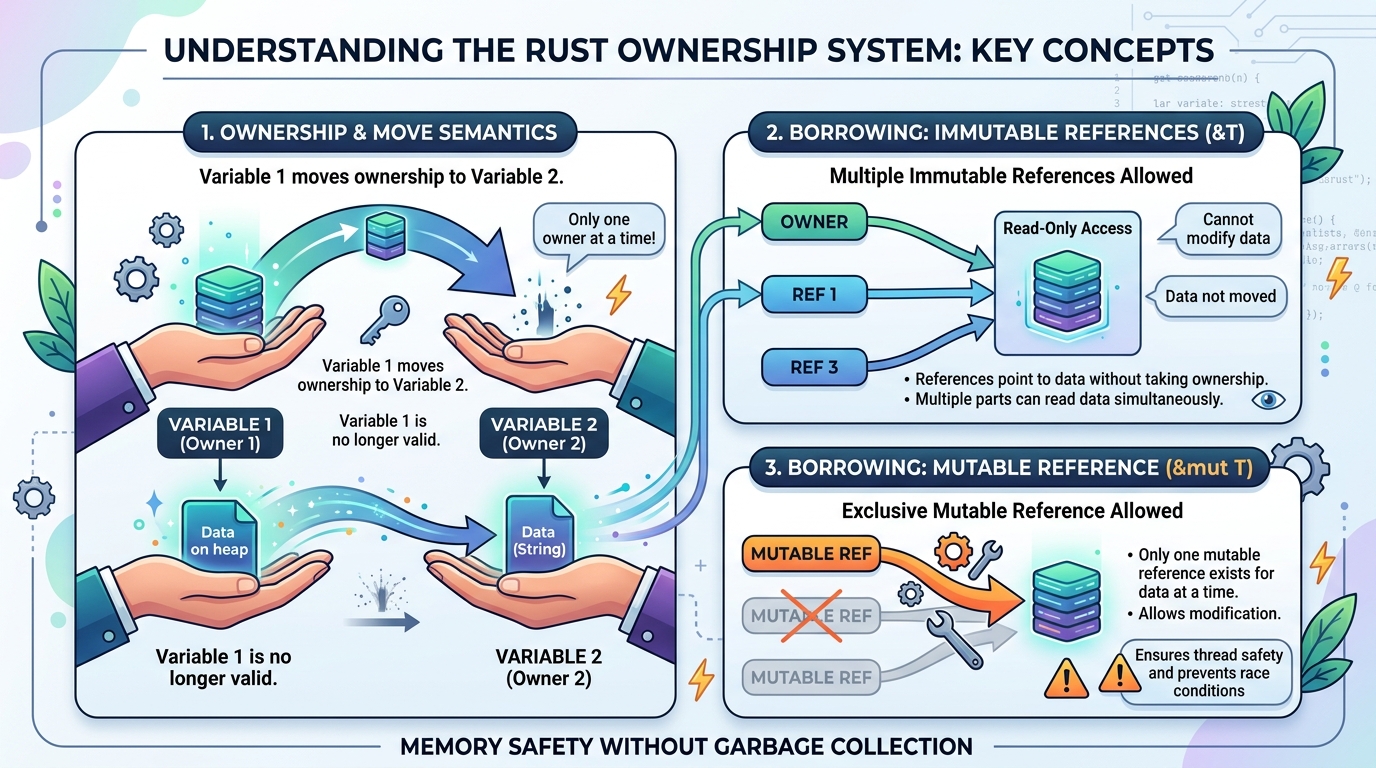
The Core Concept: Ownership
At the heart of Rust’s **Rust memory safety** lies the concept of ownership. Every value in Rust has a single owner. When the owner goes out of scope, the value is automatically dropped – meaning its memory is freed. This eliminates the need for manual memory management, a major source of errors in languages like C and C++. Rust enforces this rule rigorously. When a new variable is created, it implicitly takes ownership of the value it’s assigned. If you try to create multiple owners of the same value, Rust will prevent it, forcing you to use techniques like cloning or moving data. This simple yet powerful rule is the foundation of Rust’s memory management strategy. Consider this example:
rust
fn main() {
let s1 = String::from(“hello”); // s1 owns the string
// s1 is moved to the function
println!(“s1: {}”, s1); // This will not compile
}
This example demonstrates that once `s1` is moved, it can no longer be used. Attempting to use it would result in a compile-time error.
Borrowing: Sharing Data Safely
Rust allows you to share data without transferring ownership using borrowing. Borrowing provides a way to access a value without taking ownership. There are two types of borrows: mutable and immutable. A mutable borrow allows you to modify the value, while an immutable borrow allows you to read it. Rust’s borrow checker enforces rules to prevent data races and ensure that borrows are valid. The key rule is that you can have either one mutable borrow or any number of immutable borrows at a time. This prevents multiple parts of the code from modifying the same data simultaneously, which could lead to unpredictable behavior. Let’s look at an example:
rust
fn main() {
let mut s = String::from(“hello”);
let r1 = &s; // Immutable borrow
let r2 = &s; // Another immutable borrow
println!(“r1: {}, r2: {}”, r1, r2);
// s.push_str(” world”); // Error: Cannot borrow `s` as mutable because it is also borrowed as immutable
}
In this example, `r1` and `r2` are immutable borrows. However, attempting to modify `s` while it’s being borrowed would result in a compile-time error. To allow modification, you’d need to create a mutable borrow:
rust
fn main() {
let mut s = String::from(“hello”);
let r1 = &mut s;
r1.push_str(” world”);
println!(“s: {}”, s); // Output: s: hello world
}
This demonstrates how Rust’s borrow checker ensures that borrows are used correctly.
Lifetimes: Tracking Borrow Validity
Lifetimes are a crucial component of Rust’s **Rust memory safety** system. They are essentially annotations that describe the scope for which a reference is valid. The borrow checker uses lifetimes to ensure that references never outlive the data they point to. Lifetimes are often inferred by the compiler, but in some cases, you may need to explicitly annotate them. Lifetimes are represented by a single letter (e.g., ‘a’, ‘b’, ‘t’) and are associated with references. The compiler uses these annotations to verify that references are always valid. Consider this example:
rust
fn longest<'a>(x: &’a str, y: &’a str) -> &’a str {
if x.len() > y.len() {
x
} else {
y
}
}
In this example, `’a` is a lifetime parameter. It indicates that both `x` and `y` must live at least as long as the returned string. The compiler uses this information to ensure that the returned string is valid throughout its lifetime. Lifetimes can seem complex at first, but they are essential for maintaining **Rust memory safety** and preventing dangling pointers.
Benefits of Rust Memory Safety
The advantages of Rust’s approach to memory management are significant. Firstly, it eliminates entire classes of bugs that plague other languages. Secondly, it allows for more confident and reliable software development. Thirdly, it enables safer concurrency by preventing data races. Finally, it contributes to building more secure systems. Rust’s **Rust memory safety** isn’t just about preventing crashes; it’s about building software that is inherently more robust and trustworthy. For example, Rust is increasingly being used in operating systems, embedded systems, and web assembly, where reliability and security are paramount. Resources for further learning include the official Rust Book: [https://doc.rust-lang.org/book/](https://doc.rust-lang.org/book/) and the Rust by Example website: [https://doc.rust-lang.org/rust-by-example/](https://doc.rust-lang.org/rust-by-example/)
Conclusion
Rust’s **Rust memory safety** system is a remarkable achievement in software engineering. By combining ownership, borrowing, and lifetimes, Rust provides a powerful and effective way to prevent memory-related bugs without the need for a garbage collector. This results in code that is not only performant but also incredibly reliable and secure. As Rust continues to gain traction, its commitment to memory safety will undoubtedly play a key role in shaping the future of systems programming and beyond. Embracing Rust’s principles can significantly improve the quality and trustworthiness of your software projects.