
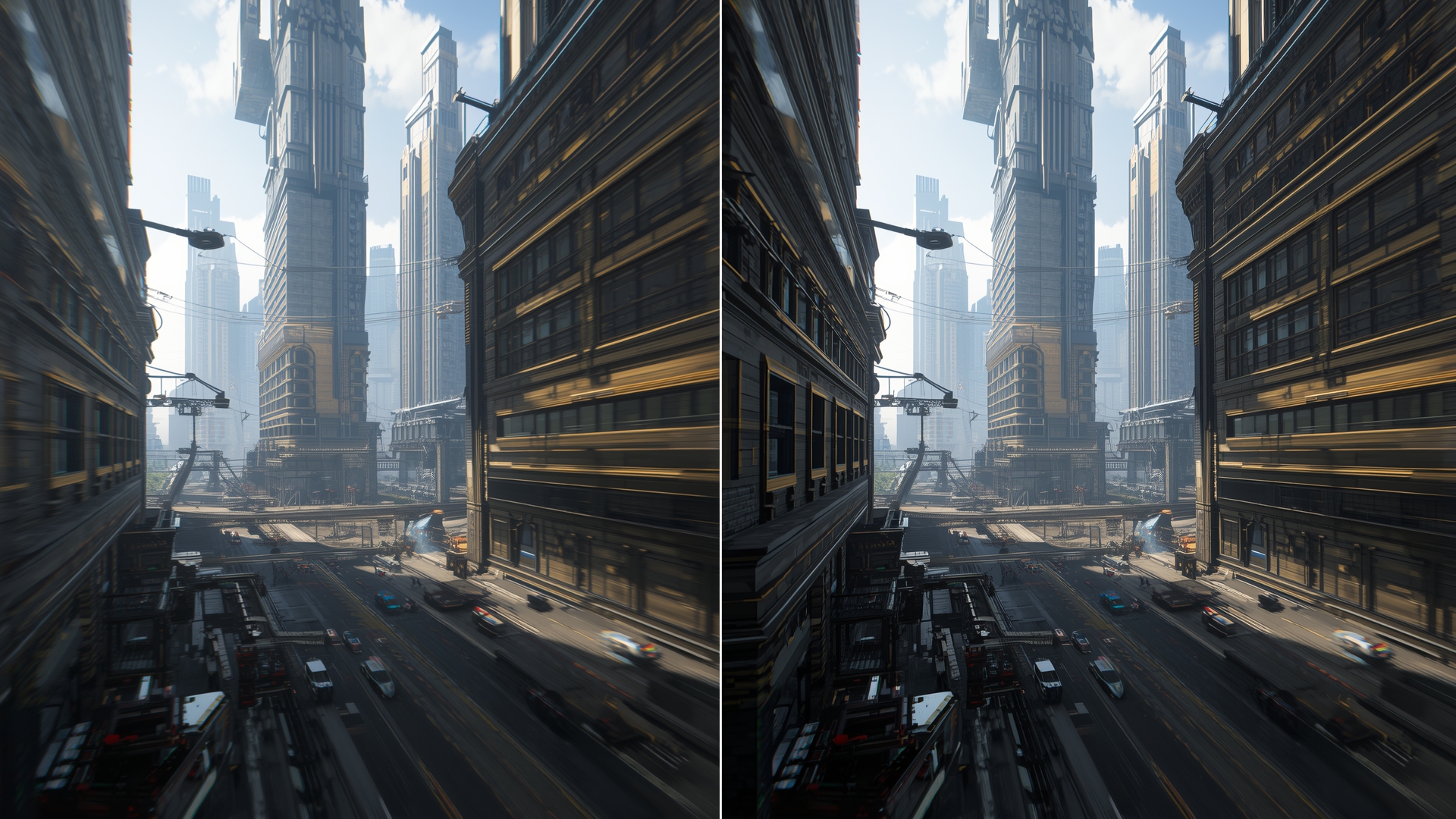
What is AI Upscaling and How Does It Work?
At its core, AI upscaling for gaming is a clever trick designed to give you the best of both worlds: high resolutions without the crushing performance cost. Instead of rendering every pixel of a 4K image, which requires immense computational power, AI upscaling renders the game at a lower resolution, perhaps 1080p or 1440p.
The real magic begins after this initial render. Specialized AI algorithms, often powered by neural networks, analyze the lower-resolution image along with temporal data (information from previous frames) and motion vectors (data indicating how objects are moving). Using this rich dataset, the AI reconstructs the image, intelligently predicting and filling in the missing pixels to achieve a much higher resolution, like 4K or even 8K. This process happens almost instantaneously, fooling your eyes into seeing a high-resolution image that your GPU didn’t have to render natively at full scale.
This method significantly reduces the workload on your graphics card, as it only has to generate a fraction of the pixels. The AI then takes over, using its learned intelligence to create the illusion of a full-resolution render, complete with enhanced details and smoother edges. It’s a testament to how far artificial intelligence has come, directly benefiting the gaming community by making demanding titles more accessible and visually stunning.
The Big Players: DLSS, FSR, and XeSS
The landscape of AI upscaling for gaming is currently dominated by three major technologies, each with its unique approach and compatibility. Understanding these differences is key to appreciating their impact.
NVIDIA DLSS (Deep Learning Super Sampling)
NVIDIA pioneered this technology, requiring dedicated Tensor Cores found exclusively in their RTX series GPUs. DLSS utilizes a deep learning neural network that is trained on super-sampled (extremely high-resolution) images of games. During gameplay, the Tensor Cores run an inference model that intelligently reconstructs the lower-resolution image into a higher one, often yielding spectacular results that can sometimes even surpass native resolution in clarity and anti-aliasing. The AI model continually learns and improves with each game integration, making DLSS a benchmark for quality and performance.
AMD FSR (FidelityFX Super Resolution)
AMD’s answer to upscaling is FSR, which takes a different, more open-source approach. Unlike DLSS, FSR doesn’t rely on dedicated AI hardware. Instead, it uses a sophisticated spatial upscaling algorithm that works across a much broader range of graphics cards, including older AMD GPUs, NVIDIA cards, and even integrated graphics. FSR analyzes the current frame and applies a series of advanced algorithms to reconstruct the higher-resolution image, followed by a sharpening pass. Its open nature makes it incredibly versatile and widely adopted, though its initial versions were sometimes perceived as less refined than DLSS in terms of artifact handling. Learn more about AMD’s FSR technology here: [https://www.amd.com/en/technologies/fidelityfx-super-resolution](https://www.amd.com/en/technologies/fidelityfx-super-resolution)
Intel XeSS (Xe Super Sampling)
Intel entered the fray with XeSS, designed to leverage the XMX AI acceleration hardware in their Arc GPUs, but also offering a broader compatibility mode that utilizes DP4a instructions, allowing it to run on a wider range of hardware, including NVIDIA and AMD GPUs. XeSS uses a neural network that is similar in concept to DLSS, trained to produce high-quality upscaled images. It strikes a balance between the hardware-specific optimizations of DLSS and the broad compatibility of FSR, aiming to deliver excellent image quality across diverse systems. Intel’s commitment to this technology indicates a future where AI upscaling becomes a ubiquitous feature regardless of your hardware vendor.
The Transformative Impact on Gaming Performance
The practical benefits of AI upscaling for gaming are immediately apparent to anyone who uses it. It’s not just about pushing pixels; it’s about making high-end gaming experiences accessible and smoother than ever before.
Boosting Frame Rates Significantly
One of the most compelling advantages of AI upscaling is its ability to dramatically boost frame rates. By rendering games at a lower internal resolution, the GPU has less work to do per frame. This directly translates to higher frames per second (FPS), which is crucial for competitive gamers seeking every advantage and for enthusiasts wanting to fully utilize high-refresh-rate monitors. For instance, a game struggling to hit 60 FPS at native 4K might easily achieve 90-120 FPS or even higher with AI upscaling enabled, transforming a choppy experience into a fluid one. This also allows gamers to enjoy more graphically intensive features like ray tracing without the prohibitive performance cost, integrating seamlessly with technologies like /understanding-ray-tracing-in-modern-games.
Maintaining and Enhancing Visual Fidelity
Crucially, these frame rate gains don’t come at the cost of visual quality. Modern AI upscaling algorithms are incredibly sophisticated, often producing an image that is nearly indistinguishable from, or in some cases even superior to, a native render. They excel at mitigating aliasing (the jagged edges seen on diagonal lines) and reconstructing fine details that might otherwise be lost. Some implementations even manage to resolve temporal anti-aliasing issues better than traditional methods, resulting in a cleaner, more stable image in motion. This ability to deliver stunning visuals at higher frame rates is a testament to the power of AI, making games look sharper and more immersive across a wide range of hardware, allowing gamers to appreciate intricate textures and environments.
Challenges and Limitations
While AI upscaling for gaming is a groundbreaking technology, it’s not without its challenges and limitations. Understanding these nuances helps temper expectations and highlights areas for future improvement.
Potential for Input Lag and Artifacts
Early iterations of AI upscaling technologies, and even current versions in specific scenarios, can sometimes introduce minor visual artifacts. These can manifest as ghosting around moving objects, shimmering on fine details (like power lines or fences), or a slight blurriness that might detract from the overall image clarity. While these issues have been significantly reduced with newer versions and better game integrations, they are still points of concern for some discerning gamers. Additionally, the process of upscaling, though rapid, does add a tiny amount of processing time, which can theoretically introduce minuscule input lag. For most players, this is imperceptible, but for competitive esports where every millisecond counts, it’s a factor worth noting.
Hardware Requirements and Game Adoption
Although FSR and XeSS offer broader compatibility, the most premium AI upscaling experiences, particularly with NVIDIA’s DLSS, still require specific, often higher-end, hardware. Dedicated Tensor Cores are not present in older GPUs or non-NVIDIA cards, limiting access to DLSS for a segment of the PC gaming population. Even for the more open solutions, a reasonably modern GPU is still beneficial for optimal performance and image quality. Furthermore, AI upscaling technologies need to be integrated by game developers, which means not every game supports every upscaling solution. While adoption is growing rapidly, some older titles or niche games might not benefit from these advancements, requiring gamers to carefully consider their hardware choice, as discussed in /choosing-the-right-gpu-for-your-gaming-pc.
The Future of AI Upscaling for Gaming
The evolution of AI upscaling for gaming is far from over. Developers and hardware manufacturers continue to refine their algorithms, pushing the boundaries of what’s possible with intelligent image reconstruction. We’re seeing constant updates, improved clarity, and reduced artifacting with each new iteration, promising an even brighter future for gaming visuals.
Evolving Algorithms and Deeper Integration
Expect to see even more sophisticated neural networks and algorithms. Future versions will likely require less computational power while delivering even better results, further blurring the lines between native and upscaled resolutions. We might see more granular control over sharpening, fidelity, and performance settings, allowing users to fine-tune the experience to their exact preferences. There’s also potential for deeper integration with game engines, where upscaling becomes an integral part of the rendering pipeline rather than an optional post-process. Imagine AI assisting not just with upscaling, but also with lighting, reflections, and even asset generation, making games more detailed and dynamic without additional load. The ongoing research and development from companies like NVIDIA ([https://www.nvidia.com/en-us/geforce/technologies/dlss/](https://www.nvidia.com/en-us/geforce/technologies/dlss/)) indicate a continuous push for perfection.
Broader Adoption and Console Integration
AI upscaling is already a core component of modern PC gaming, but its influence is set to expand. We can anticipate broader adoption across almost all new game releases, making it a standard feature rather than an optional extra. Crucially, similar temporal reconstruction and upscaling technologies are already fundamental to current-generation consoles like the PlayStation 5 and Xbox Series X/S, enabling them to deliver 4K experiences on less powerful hardware than high-end PCs. This trend will undoubtedly continue, with future console generations likely featuring dedicated AI hardware to further enhance their upscaling capabilities. This widespread integration will cement AI upscaling for gaming as a fundamental pillar of modern graphics, making high-fidelity visuals accessible to a much larger audience across all platforms.
Conclusion
AI upscaling for gaming represents one of the most significant technological advancements in recent years, fundamentally altering the performance-to-fidelity equation for gamers. From NVIDIA’s Tensor Core-powered DLSS to AMD’s broadly compatible FSR and Intel’s promising XeSS, these technologies are democratizing high-resolution gaming, allowing more players to experience titles with stunning visuals and buttery-smooth frame rates without the need for constant, prohibitively expensive hardware upgrades. While challenges remain in terms of minor artifacts and universal adoption, the rapid pace of innovation suggests a future where these imperfections are continually ironed out. As AI algorithms grow smarter and hardware becomes more integrated, AI upscaling for gaming will continue to evolve, pushing the boundaries of immersive experiences and ensuring that the future of gaming looks clearer, sharper, and more fluid than ever before.